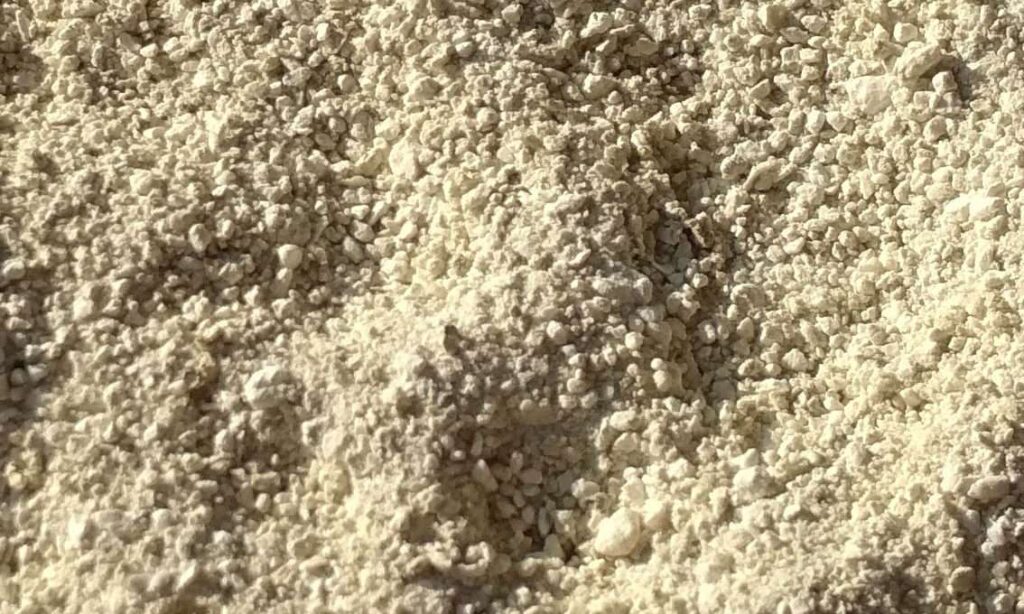
Soil-conditioning limestone grind
Soil conditioner
Soil-conditioning limestone grind – natural soft limestone with a high CaCO₃ content, dissolves quickly, improves soil structure and supports vigorous plant growth.
- CaCO3 content
- 88-93%
- CaO content
- 49-52%
- Packaging
- 25 kg · 50 kg · 1,000 kg
What makes the limestone of Zebegény (the White Gold of Zebegény) an effective soil conditioner is its readily soluble calcareous-marl character and its young geological age: the weakly cemented, porous grain falls apart in soil moisture and reacts over a large surface area, whereas grains of limestone flour ground from hard limestone stay recognisable in the soil for years. Its active content is 88–93% CaCO3, corresponding to 49–52% CaO.
The soil-conditioning limestone grind (carbonate of lime) is made from soft limestone by drying and classification. Thanks to the drying it absorbs moisture well; applied to the soil it breaks down and dissolves quickly, becoming available to plants fast and in large quantities.
This soft limestone, extracted at our own quarry, formed as a marine sediment roughly 15 million years ago. The quarried material consists almost entirely of organic remains: fossils, shells of marine molluscs and corals embedded in a calcareous marl sediment formed from algae.
Advances in soil-conditioning technology have made it possible to extend the liming season, traditionally running from just after the early harvest until late autumn, across the whole year. In Western Europe the material is spread on stubble, on frozen ground, and even over standing crops (the limestone powder we supply is not caustic to plants). That period is in fact better suited to liming, because at the autumn and spring water maxima the water saturates the soil completely and, being cold, carries a lot of carbon dioxide, which helps the lime dissolve and spread through the soil. Soil structure and the water and air regime improve, organic matter quality gets better, and the soil’s tendency to crust and its resistance to tillage implements both decrease. Through the combined effect of a favourable pH and an improving water and air regime, the number of micro-organisms grows and soil life becomes more active. Atmospheric nitrogen fixation increases, nitrification intensifies, nutrient release accelerates, fertiliser utilisation improves, and the carbohydrate, ascorbic acid and carotene content of plants rises. Liming significantly increases the shelf life of various crops and the yield of stone fruits.
Lime fertilisation never became widespread in Hungary. Part of the calcium removed by the crop is replaced with various mineral fertilisers. Heavy mineral fertilisation, however, acidifies our soils, which is what justifies liming them with a natural material.
The soil-conditioning limestone grind is available in Zebegény in 25 kg, 50 kg and 1,000 kg (Big-Bag) packaging. We are glad to send information on calculating the amendment requirement and on carrying out the liming. Call us.
Download the soil improvement guide (in Hungarian)
A short word on the role of soil conditioning
Soil improvement is fundamental in agriculture, since every farmer has an interest in a high yield and therefore in a profitable business. Crushed soil-conditioning limestone brings a number of benefits, set out below.
Using a soil conditioner changes the structure of the soil, and as the water and air regime improves the number of micro-organisms increases significantly. Nitrogen fixation also becomes more effective, so the fertiliser applied to the soil is utilised better. Through these combined effects plants can develop more healthily, their nutrient and vitamin content rises, and their shelf life improves as well. The conclusion is that using a soil conditioner is practically indispensable.
If you need a soil conditioner, choose our product, the soil-conditioning limestone grind. If you have questions, or would like to place an order, contact us on one of our contact details.

Request a quote
Tell us what you need it for and in what quantity — we call you back with the exact ex-works price.