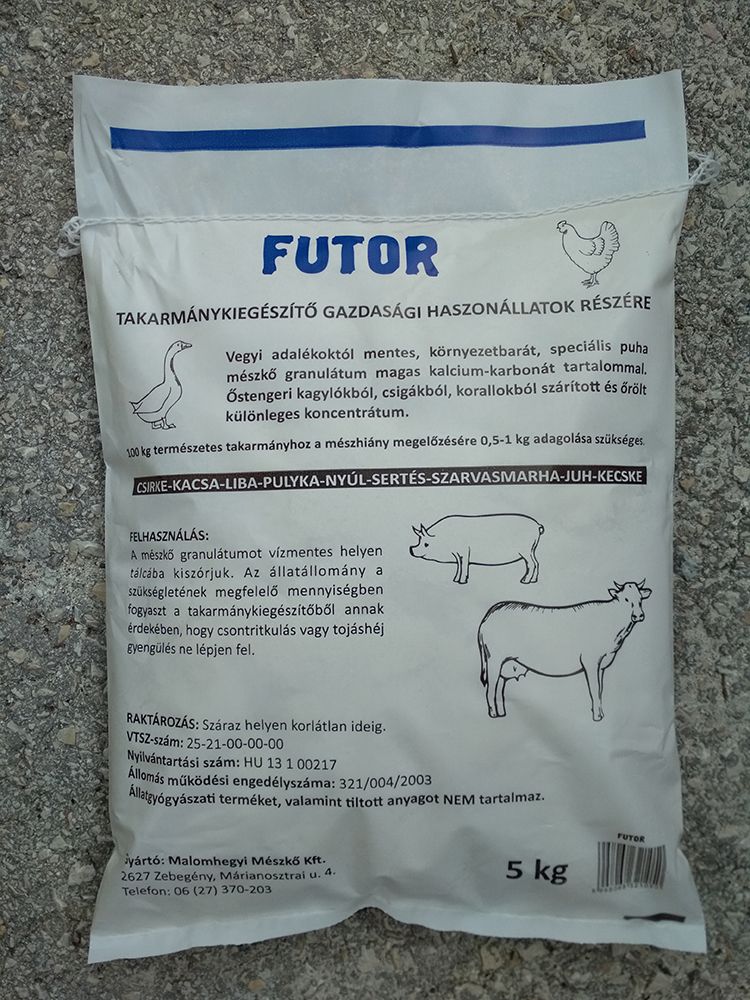
Futor
Particle size0 mm – 1.2 mm
Futor feed lime: a calcium supplement made from soft limestone with a high CaCO₃ content for poultry, pigs and farm animals, easy to mix into feed.
Packaging: 5 kg · 25 kg · 50 kg · Big-Bag
Details
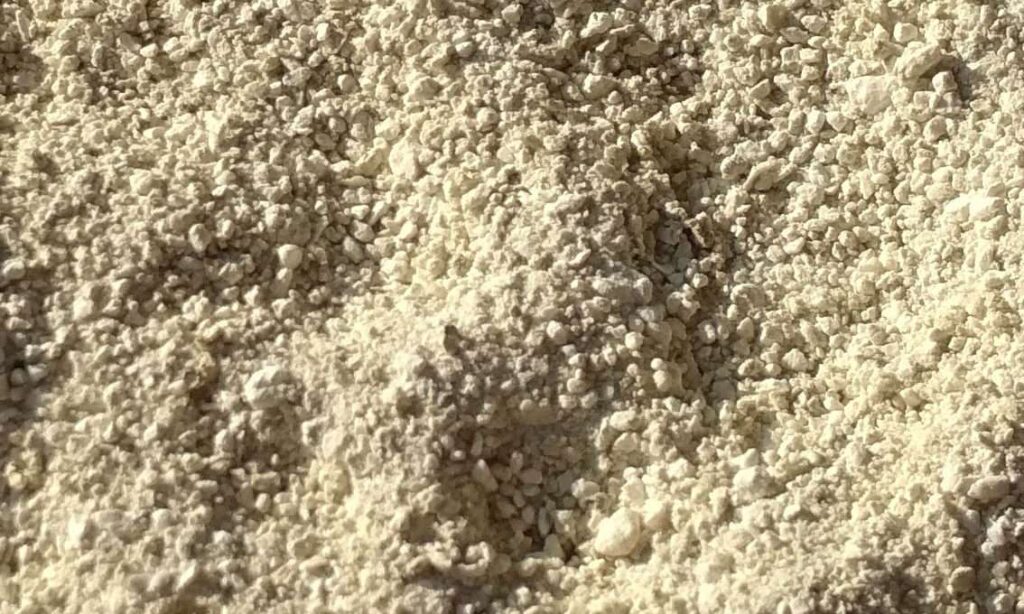
Zebegény · our own open-pit quarry
The soft limestone we extract at our quarry in Zebegény contains 88–93% CaCO₃. It is a young, porous calcareous marl: in acid — and therefore in animal stomachs and in the soil alike — it reacts over a far larger surface area than feed lime ground from dense, hard limestone.
Five grinds from one quarry: for animal feed, soil improvement and paint.
Particle size0 mm – 1.2 mm
Futor feed lime: a calcium supplement made from soft limestone with a high CaCO₃ content for poultry, pigs and farm animals, easy to mix into feed.
Packaging: 5 kg · 25 kg · 50 kg · Big-Bag
Details
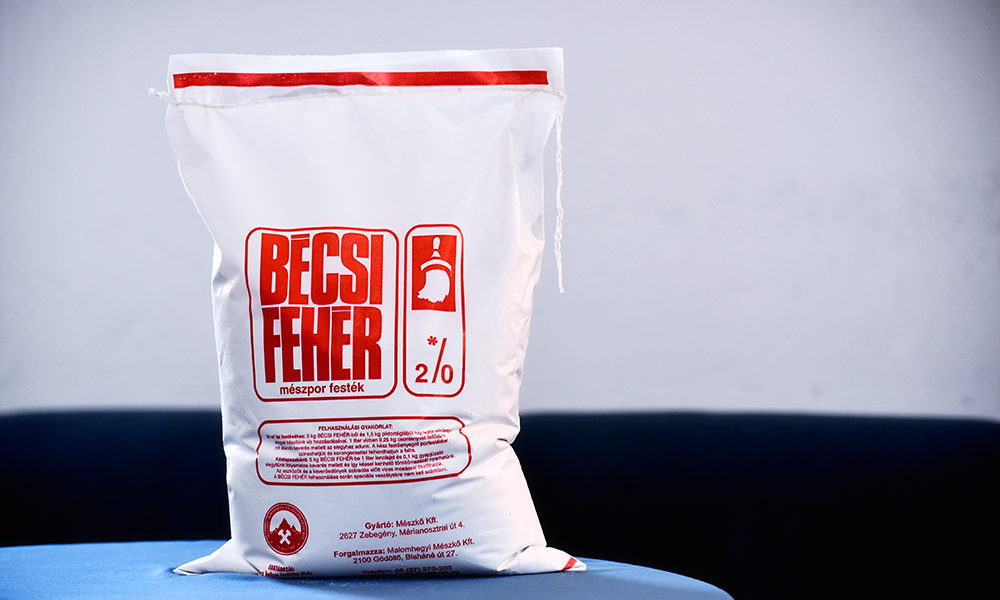
Particle sizeflour-fine grind
Vienna white: flour-fine soft limestone, the raw material of traditional lime paint. Good coverage and adhesion, a vapour-permeable surface, mixable with any pigment.
Packaging: 5 kg · 4×5 kg · 40 kg
Details
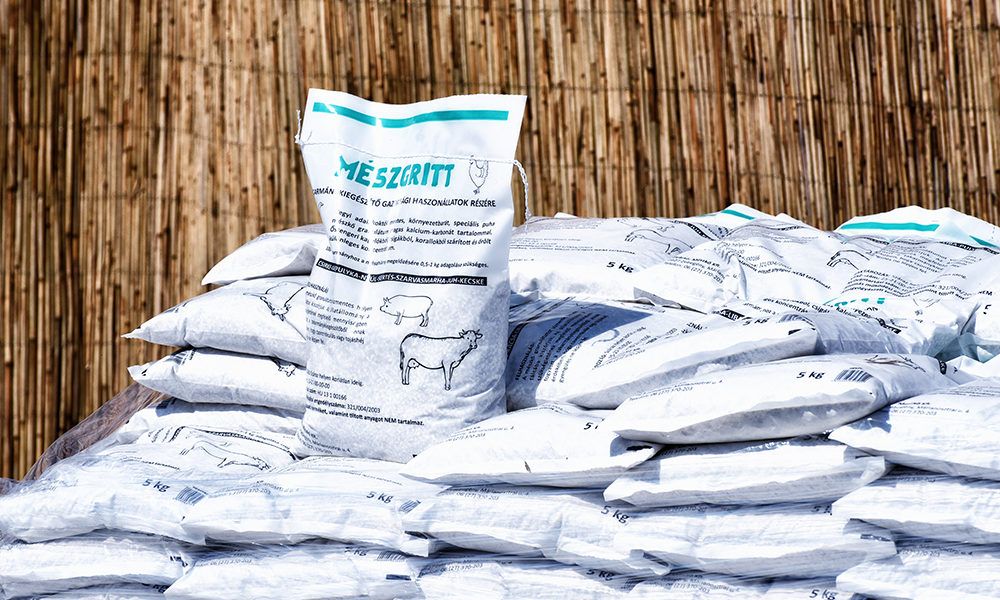
Particle size1.2 mm – 5 mm
Lime grit – soft limestone granulate (1.2–5 mm), a feed supplement for poultry and farm animals. Guaranteed calcium content of at least 36%, free of chemical additives.
Packaging: 5 kg · 25 kg · 50 kg · Big-Bag
Details
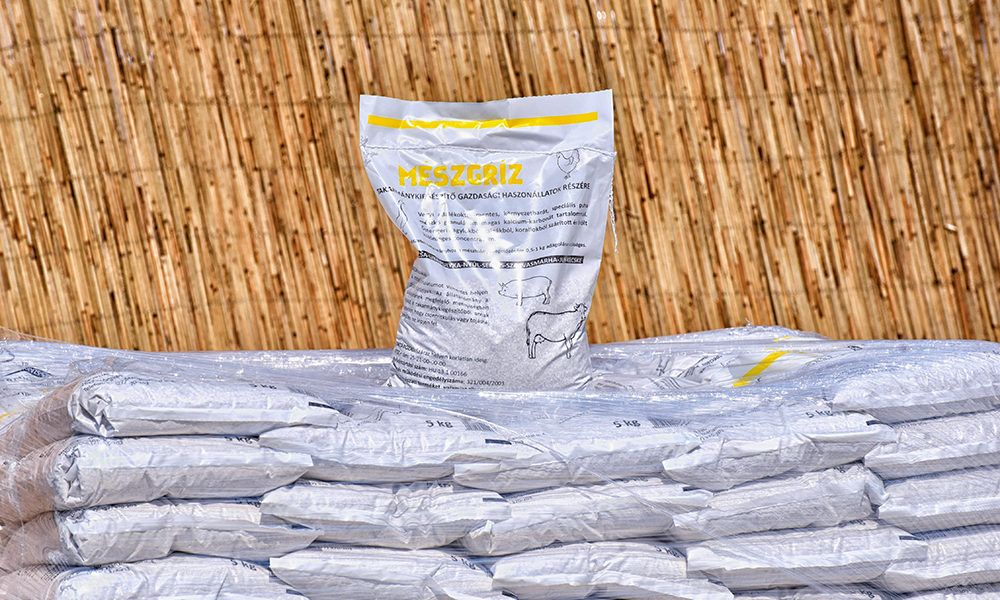
Particle size1.2 mm – 4 mm
Lime meal – soft limestone of semolina particle size, a feed supplement for poultry and farm animals. High calcium content, easy to mix, free of chemicals.
Packaging: 5 kg · 25 kg · 50 kg · Big-Bag
Details
CaCO3 content88-93%
Soil-conditioning limestone grind – natural soft limestone with a high CaCO₃ content, dissolves quickly, improves soil structure and supports vigorous plant growth.
Packaging: 25 kg · 50 kg · 1,000 kg
Details
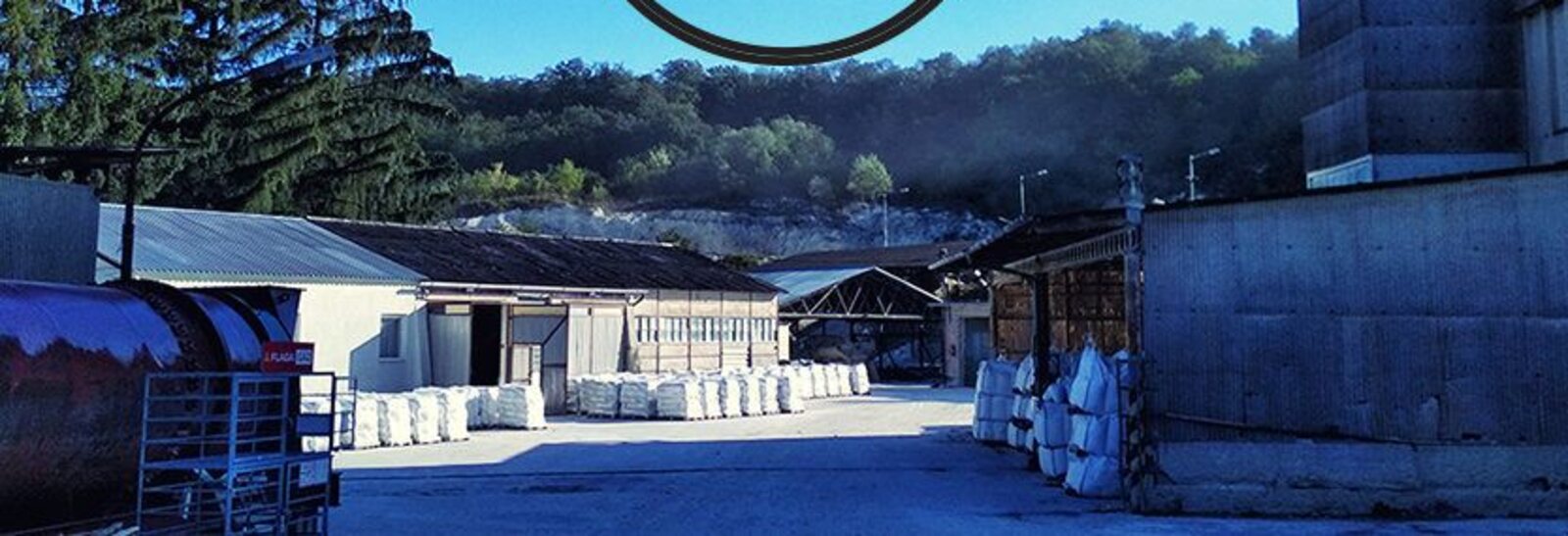
The open-pit quarry of MALOMHEGYI MÉSZKŐ KFT. lies 2 km north-west of the village of Zebegény, Hungary. In wider terms it belongs to the south-south-western part of the Börzsöny mountains in the Danube Bend. The soft limestone extracted here formed as a marine sediment roughly 15 million years ago, which is young in geological terms.
The quarried material consists almost entirely of organic remains. Fossils ranging from a few millimetres to several tens of centimetres — shells of marine molluscs and corals — are embedded in a calcareous marl sediment formed from algae.
The sediment contains a readily measurable amount of phosphate, which is why its use as feed lime was already recommended at the beginning of the last century.
This very young calcium carbonate (active content 88–93% CaCO3), with a calcium content of 39.81%, dissolves readily in any acid — including the gastric acid of animals — so it is utilised far better than feed limes made from hard limestone, which are almost insoluble in acid. And if utilisation is better, then naturally a considerably smaller quantity achieves the same effect.
Our products are available in 5 kg bags, 4×5 kg multipacks, 25 kg and 50 kg sacks, and Big-Bags (1 tonne).
We also undertake contract grinding of minerals supplied by the customer: with our Loesche mill, our roller and hammer crushers and our direct-current drum dryers we produce mineral flour or carry out classified crushing.
Materials we grind most often: soft and hard limestone, bentonite, kaolin, clay, sandstone, mineral salts, barite, magnesite, chamotte, silicate, corundum, porcelain and others. Grinding fineness from 100 micrometres.
At our plant the products are given modern packaging and our customers are served with mechanised material handling.
Returning customers who commit their expected use in a contract can receive a significant discount (5% from 5 tonnes, 10% from 10 tonnes).
88-93%
39.81%
15 million years
5-10%
Created by nature. Perfected by us.
Volume discount
Returning customers who commit their expected annual use in a contract can receive a significant discount.
Following the principles of sustainable crop production requires that, whatever the financial pressures, we take increased care to maintain the lime status of the soil — which is at the same time an important step towards preserving a satisfactory soil structure, maintaining acceptable porosity and achieving balanced plant nutrition. Taking the soil improvement carried out so far into account, the area in need of improvement in Hungary is some 2.8 million hectares out of a total of 4.2 million hectares of agricultural land. Of this, 2.2 million hectares is acidic soil.
According to Filep (1988), lime fertilisation never became widespread in Hungary. The calcium supply of plants is secured on calcareous and saturated soils. The amount of calcium removed annually by the crop is 10–30 kg/ha for cereals, 50–90 kg/ha for row crops and 150–200 kg/ha for legumes. Part of the calcium removed by the crop can be replaced with superphosphate or calcium ammonium nitrate. Heavy mineral fertilisation, however, acidifies our soils, which is what justifies liming them.
As with every intervention affecting the soil — nutrient replenishment, liming or any other melioration — the soil must be tested in a soil laboratory first.
The intervention can then be planned on the basis of the results. Liming can be used to improve acidic soils; it is not a suitable method for improving sodic soils.
Acidic soils contain a relatively large amount of H+ ions (protons), and this affects soil structure, chemical properties and biological activity alike.
To increase fertility, however, every acidic soil needs its harmful acidity eliminated and agrotechnical methods matched to the soil’s properties. (Source: Filep, Stefanovits, Füleky)
The effect of lime on the mobility of nutrients in the soil can generally be called positive in terms of nutrient utilisation by plants. The amount of some substances decreases when the soil acidifies, while others increase. By thoroughly changing the pH of the medium, liming has a very large influence on the mobility of the nutrients present in the soil.
Avdonyin (1972) demonstrated that as soils acidify the number of bacteria decreases while the number of fungi increases significantly. Most bacteria do not develop below a pH of 4.5–5, while the bacteria that oxidise sulphur are characterised by high acid tolerance. Excessive soil acidification is particularly unfavourable for the development of micro-organisms such as Azotobacter and root-nodule bacteria (rhizobia), which enrich the soil with atmospheric nitrogen. Liming was especially favourable for important micro-organisms such as the nitrifiers, clostridium species and cellulose decomposers, which play an important role in increasing soil fertility.
Micro-organisms in relation to the pH of the medium:
| Soil pH | Bacteria per g of soil | Soil pH | Fungi per g of soil |
|---|---|---|---|
| 6.2 | 13600000 | 6.6 | 26200 |
| 5.6 | 12600000 | 6.2 | 39100 |
| 5.1 | 4800000 | 5.8 | 73000 |
| 4.8 | 4000000 | 4.0 | 110000 |
Micro-organisms in relation to the pH of the medium:
| Micro-organism | pH values possible for development | ||
|---|---|---|---|
| Minimum | Optimum | Maximum | |
| Putrefactive bacteria | 4.5 | 7 | 6 |
| Nodule bacteria | 4.3 | 7 | 10 |
| Azotobacter | 5 | 7 | 9 |
| Nitrifiers | 4 | 7.8-8.0 | 10 |
| Actinomyces | 4.5 | 7 | 9 |
| Moulds | 1.5 | 7 | 9 |
Source: Avdonyin, N. S. (1972): Increasing the fertility of acidic soils
The tests described below are carried out by soil laboratories.
Based on the work of Kádár (1998), when the pH of the soil solution is below 7 we speak of actual acidity, characterised by pH(H2O). Soil pH is measured in a 1:2.5 aqueous suspension. If an acidic soil is shaken out with 1 M KCl, a lower value is obtained, because the cation of the neutral salt exchanges K+ for H+ on the surface of the colloids. This exchangeable acidity is of course greater than the actual acidity. In strongly acidic soils not only adsorbed H+ but also Al3+ is exchanged and enters the solution, and Al3+ is toxic to plants. Cation exchange reactions also take place with mineral fertilisers, so choosing the right fertiliser form matters. If the soil is treated with alkaline-hydrolysing Na acetate (a strong base and a weak acid), a stronger H+ exchange occurs. This is called hydrolytic acidity and is denoted y1. y1 exchanges all the H+ ions of the soil, whereas KCl exchanges only the readily exchangeable ions. In neutral or slightly acidic soils only hydrolytic acidity can be measured meaningfully; exchange acidity is negligible.
Several theoretical and empirical methods can be used to determine the lime dose needed to improve an acidic soil.
In practice the lime dose has for decades been calculated from the hydrolytic acidity (y1) and the binding number (KA).
The formula below gives the CaCO3 dose needed to lime the top 20 cm layer of one hectare.
CaCO3 t/ha = y1 × (KA/100) × 1.74 = tonnes of CaCO3 active content per hectare
The calculated amount refers to pure CaCO3, so when setting the dose of amendment actually applied, the CaCO3 content of the material used must also be taken into account.
| pH value | < 4.5 | 4.5 - 5.2 | 5.3 - 6.4 | 6.5 - 7.4 | 7.5 - 8.2 | 8.2 - 9.0 | 9.0 < |
|---|---|---|---|---|---|---|---|
| soil | strongly acidic | acidic | slightly acidic | neutral | slightly alkaline | alkaline | strongly alkaline |
Tell us what you need it for and in what quantity — we call you back with the exact ex-works price.